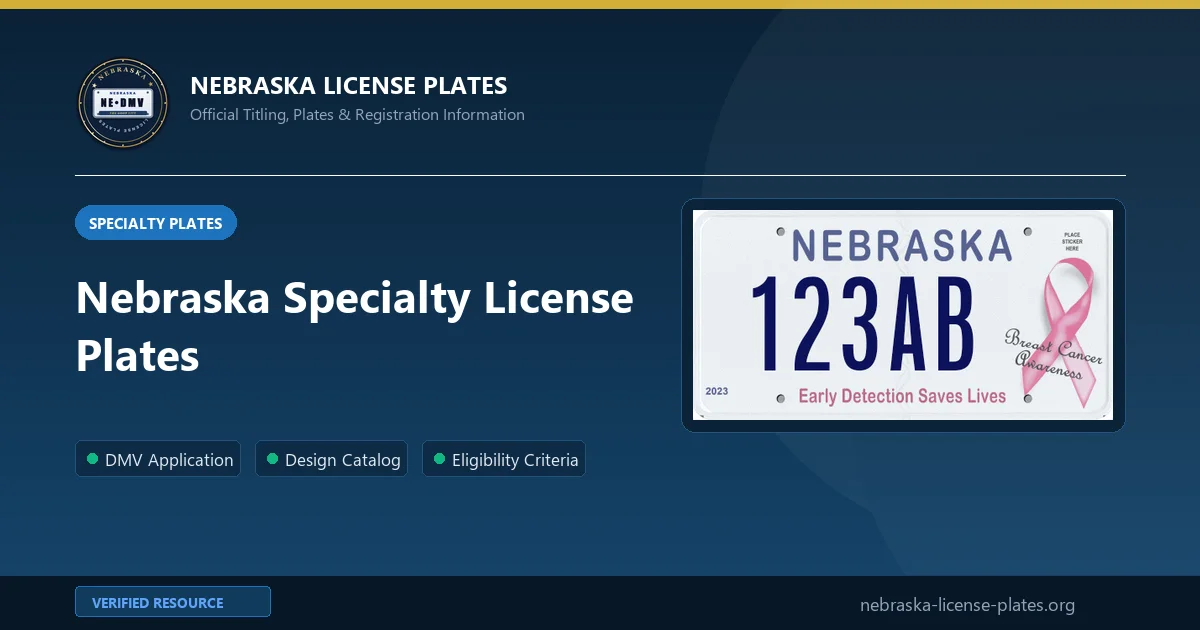
Nebraska specialty license plates turn the standard county-coded tag into a rolling statement: cause designs from breast cancer awareness to mountain lion conservation, organization plates from amateur radio to Husker fandom, and message plates that carry a custom character combination for a $40 fee. Every specialty design runs inside the same registration system, issued through county treasurers and the DMV specialty programs, charged on top of standard registration, and subject to the same display statutes as any plate on Nebraska roads.
Nebraska specialty plate designs split into programs with distinct rules. Cause plates fund the missions printed on them; organization plates need membership or eligibility documents; message plates screen custom combinations against issued plates and DMV content standards. This page walks the full catalog: what each program charges, what documents each demands, how the application runs, and what changes when Legislative Bill 97’s single-plate reissue arrives in 2029.
How To Order Nebraska Specialty License Plates
Successfully completing the legal and administrative requirements for how to order nebraska specialty license plates requires a structured, step-by-step approach coordinated between state DMV requirements and county processing counters. Following the verified statutory sequence ensures your application, certificate of title, and registration tags are validated without administrative rejection. Proceed through each procedural stage in the exact order detailed below.
- Pick the design: the Nebraska plate gallery shows every design with its photo, and the DMV license plates page lists every active program with its application path.
- Gather eligibility documents: cause plates need none; organization plates need membership proof; military-adjacent plates need veteran registry enrollment.
- Apply through the county treasurer or the DMV specialty portal: the counter takes the application, the fee stack, and the surrendered current plates.
- Wait for production: the standard plates stay on the car until the specialty design arrives by mail.
Processing time runs longer than a standard plate swap, specialty designs print on program schedules, and the current tag keeps the car legal on the road until the swap.
Specialty Plate Programs and What Each Costs
Total financial obligations for specialty plate programs and what each costs are governed by standardized statutory schedules set forth under Chapter 60 and Chapter 77 of the Nebraska Revised Statutes. Fees are collected directly by your local County Treasurer and comprise multiple distinct lines, including state motor vehicle taxes based on age and MSRP, county administrative charges, and local municipal wheel taxes where applicable. The essential fee classifications and payment structures are broken down as follows.

| Item | Fee | Notes |
|---|---|---|
| State plate fee | $4.10 | Section 60-3,102 — base plate charge |
| County official fee | $1.50 | Section 60-3,141 |
| Message plate combination | $40.00 | Custom character screening and issue |
| Specialty program production | Set per program | Printed on the DMV program page |
| Motor vehicle tax | Annual, by MSRP, age, weight | Unchanged by plate design |
The specialty surcharge funds the cause where the design carries one, breast cancer awareness, Donate Life, prostate cancer, Down syndrome, and the conservation programs route their production premiums to their missions. Organization plates, from amateur radio to Native American heritage and Nebraska history, carry their program’s production fee with eligibility documents attached.
Cause Plates: Designs That Fund Missions
Navigating the administrative rules and practical requirements for cause plates: designs that fund missions requires careful attention to both Nebraska Department of Motor Vehicles regulations and local County Treasurer practices. Whether you are managing personal vehicle compliance or handling complex multi-party automotive transactions, proper preparation is key to a seamless process. Review the essential guidelines, statutory criteria, and actionable recommendations detailed below.
- Breast Cancer Awareness: the pink-ribbon design funds awareness programs.
- Mountain Lion Conservation: the big-cat design supports conservation work.
- Bighorn Sheep: the sheep design backs habitat programs.
- Sandhill Crane: the migration-icon design funds crane habitat work.
- Box Turtle: the reptile design supports wildlife programs.
- Donate Life: the organ-donation design promotes the donor registry.
- Choose Life: the advocacy design funds its mission.
- Down Syndrome Awareness: the awareness design supports its community.
- Prostate Cancer: the blue-design awareness plate funds screening programs.
- Sammy’s Superheroes: the childhood-illness design funds its foundation.
- Vets Get Pets: the veteran-animal design supports its program.
- Josh the Otter: the water-safety design funds child safety education.
Cause plates need no eligibility documents, any Nebraska registrant can order one, and the production premium routes to the mission printed on the tag.
Organization Plates: Membership on the Tag
Navigating the administrative rules and practical requirements for organization plates: membership on the tag requires careful attention to both Nebraska Department of Motor Vehicles regulations and local County Treasurer practices. Whether you are managing personal vehicle compliance or handling complex multi-party automotive transactions, proper preparation is key to a seamless process. Review the essential guidelines, statutory criteria, and actionable recommendations detailed below.

- Amateur Radio: the operator-design plate needs a valid FCC amateur license.
- Native American Heritage: the heritage design carries its program’s documentation rules.
- Nebraska History: the history design supports the state historical work.
- Husker Plates: the fandom design needs no membership proof, the fan base is the program.
- Support the Arts: the arts design funds arts programming.
- Support Our Troops: the troop-support design funds its mission.
Organization plates stay with the approved applicant when the vehicle sells. The program plate belongs to the person, not the car, and returns to the treasurer counter when the program ends.
Message Plates: Custom Combinations and the $40 Fee
Total financial obligations for message plates: custom combinations and the $40 fee are governed by standardized statutory schedules set forth under Chapter 60 and Chapter 77 of the Nebraska Revised Statutes. Fees are collected directly by your local County Treasurer and comprise multiple distinct lines, including state motor vehicle taxes based on age and MSRP, county administrative charges, and local municipal wheel taxes where applicable. The essential fee classifications and payment structures are broken down as follows.
- Availability: the combination cannot duplicate any issued plate; the DMV online portal screens requests live.
- Content standards: combinations the department reads as confusing, offensive, or improper fail review.
- Format limits: character counts follow the plate format; the checker rejects overruns at entry.
Douglas, Lancaster, and Sarpy counties run county message plate programs alongside the state design, same $40 structure, county-level screening, and the county identity printed on the tag.
County Message Plates: Douglas, Lancaster, Sarpy
The three largest counties issue their own message plate designs, a driver in Omaha, Lincoln, or the Sarpy suburbs can put a custom combination on a plate that names the home county. The program runs on the same $40 structure as the state message plate, with screening through the county’s channel and production on the county design.
County message plates answer a question the standard county coding raises: why carry a county identity when the tag already codes the county? The county design states it outright, the county name on the plate, the custom combination after it, and the same statutory fee stack on top.
Historical Plates and the Antique Rule
Motor vehicle standards in Nebraska are codified under Nebraska Revised Statutes Chapter 60, establishing mandatory operational criteria for every vehicle on public roadways. Both state administrative directives and local county enforcement operate under these statutory mandates to maintain statewide public safety and vehicle identification integrity. The core legal rules and statutory obligations governing this area include.
- Hobby drives, parades, and test runs: the registration covers collector use, not daily driving.
- Age thresholds: the historical class follows the vehicle-age statutes.
- Fee structure: the historical registration carries its own fee schedule below standard registration.
Drivers who register a collector car as historical and then drive it daily sit outside the use limits, the registration class writes the rules on the road, not just on paper.
Disability Plates and Placards
Navigating the administrative rules and practical requirements for disability plates and placards requires careful attention to both Nebraska Department of Motor Vehicles regulations and local County Treasurer practices. Whether you are managing personal vehicle compliance or handling complex multi-party automotive transactions, proper preparation is key to a seamless process. Review the essential guidelines, statutory criteria, and actionable recommendations detailed below.
- Permanent disability plates: a physician’s certification files with the registration.
- Temporary placards: certifications with end dates renew on the medical schedule.
- Placard display: the placard hangs on the mirror when the certified person rides or drives.
The disability program runs on medical certification rather than cause enrollment, the plate opens parking access the certification supports, and misuse carries its own penalty class. The certification sets the term: permanent certifications hold on the registration, dated certifications renew when the medical schedule ends, and the placard’s mirror position matters, parking officers read the tag through the glass, so a placard on the seat reads as no placard at all.
Military and Veteran Plates
Navigating the administrative rules and practical requirements for military and veteran plates requires careful attention to both Nebraska Department of Motor Vehicles regulations and local County Treasurer practices. Whether you are managing personal vehicle compliance or handling complex multi-party automotive transactions, proper preparation is key to a seamless process. Review the essential guidelines, statutory criteria, and actionable recommendations detailed below.
- Veteran plates: veteran registry enrollment or discharge papers file with the application.
- Support Our Troops design: the troop-support tag needs no service proof; it funds the mission.
- Gold Star family plates: the fallen-service design carries its documentation rules.
Military plates follow the same production-fee structure as cause plates, with the service proof attached where the design demands it, the DMV program page lists the document set for each issue.
What Changes for Specialty Plates in 2029
Enacted by state lawmakers in April 2025, Legislative Bill 97 officially concludes front license plate issuance beginning with the comprehensive 2029 plate reissue cycle. Specialty license plate programs, including collegiate, historical, and organizational designs, will fully transition to single rear plate display alongside standard passenger registrations. Until this statutory transition takes effect across individual renewal dates, all registered specialty tags must continue displaying dual front and rear plates in compliance with exterior mounting standards.
- One specialty plate instead of two: the production fee stack halves for two-plate vehicles at reissue.
- Multiyear registration: qualifying vehicles register beyond a single year, fewer treasurer visits.
- Program designs carry forward: the change touches the plate count, not the catalog.
Until the 2029 cycle reaches a registration, the two-plate display rule stays in force, Section 60-3,100 and Section 60-399 apply to specialty tags exactly as they apply to the standard county-coded plate.
Specialty Plate Display Rules
Motor vehicle standards in Nebraska are codified under Nebraska Revised Statutes Chapter 60, establishing mandatory operational criteria for every vehicle on public roadways. Both state administrative directives and local county enforcement operate under these statutory mandates to maintain statewide public safety and vehicle identification integrity. The core legal rules and statutory obligations governing this area include.
Two plates on two-plate vehicles through the current cycle, front and rear, upright, visible. Covers and frames cannot obscure characters, and the specialty artwork sits behind the same readability test. Program plates stay with the approved applicant when the vehicle sells.
A specialty plate does not buy display leniency. The artwork changes; the statute does not.
The Standard Plate: What Specialty Designs Replace
The standard Nebraska plate carries the county-coded serial that has marked the state’s tags since 1922, refreshed on a reissue cycle that replaces physical plates roughly every five years. The current standard issue pairs the state identity with the county prefix. Douglas, Lancaster, and their neighbors hold the low ranges the 1922 vehicle-count system assigned, and the letter formats that followed in 1951 and later eras built on the same county logic.
Specialty designs swap the county-coded face for program artwork, yet the registration underneath runs on the same statute stack: the same $4.10 plate fee, the same $1.50 county official fee, the same staggered renewal calendar by surname. The specialty premium buys the artwork and the mission; the legal plate underneath stays identical.
The reissue cycle matters for specialty applicants on timing. A specialty application filed months before the county’s reissue window can land in the same production queue as the cycle refresh. Counter staff quote the current wait at application, and the current plates keep the car legal until the specialty tag arrives.
Reading the Specialty Catalog: What Each Program Page Shows
Evaluating active specialty plate offerings requires examining statutory qualification rules, designated nonprofit beneficiaries, and applicable administrative production surcharges. Every specialty plate authorized under Nebraska law supports a specific conservation initiative, public institution, or military service organization. The comprehensive catalog breakdown below outlines annual program fees, eligible vehicle categories, and mandatory verification credentials required at the county counter.
- Artwork: the current design print; designs refresh on program schedules, so the tag on the road matches the catalog at issue.
- Fee line: the program production premium above the standard stack; cause designs note the mission the premium funds.
- Eligibility documents: blank for cause plates, listed for organization and military plates; the counter rejects applications that arrive without them.
- Program status: active designs issue now; retired designs stop at the program’s end date, and holders keep valid tags until the registration cycle closes.
The catalog shifts as programs launch and retire, legislative sessions add cause designs by statute, and the DMV page reflects each change at launch. Specialty buyers confirm the design’s status at application rather than relying on saved screenshots from an earlier catalog.
Specialty Plates for Motorcycles and Other Classes
Different equipment categories follow specialized registration paths, including distinct rules and fee schedules for Nebraska trailer plates. State statutes establish distinct administrative tracks depending on vehicle weight, operational purpose, and ownership structure. Compare the specific operational requirements, statutory criteria, and administrative impacts below.
- Motorcycles: single-plate class, rear mount; message combinations run on the motorcycle format with its shorter character count.
- Trucks and pickups: the passenger-truck classes carry the same specialty catalog with the truck fee schedule.
- Trailers: the trailer classes follow their own plate rules; specialty availability follows the program’s class coverage.
Class matching governs the transfer rule the same way it governs standard plates: a specialty tag moves between vehicles of the same class through the county treasurer, and class mismatches end at the counter. The program premium does not buy a class exception.
Application Troubleshooting: Where Specialty Orders Stall
Administrative filings for nebraska specialty license plates frequently encounter delays due to incomplete documentation, missing notarized signatures, or mismatched record details at the county counter. Because Nebraska County Treasurers must strictly follow state Department of Motor Vehicles regulations, even minor paperwork discrepancies will halt processing until cured. To protect your transaction timeline, avoid these common administrative filing errors.
- Missing eligibility documents: organization and military plates reject without proof; the counter returns the application instead of holding it.
- Message combination conflicts: the portal screens duplicates live, yet issued-plate records update continuously, a combination available at breakfast can fail by afternoon.
- Registration holds: a lapsed insurance flag or an unpaid motor vehicle tax blocks the specialty issue until the hold clears at the treasurer counter.
- Situs county mismatches: the application files in the county where the vehicle lives most of the year; a recent move without a registration change stalls the order until the situs record updates.
Each stall clears at the counter that raised it, documents file, combinations rescreen, holds clear, and situs records update, then the application runs again from the start.
Specialty Plates and Resale Value
Navigating the administrative rules and practical requirements for specialty plates and resale value requires careful attention to both Nebraska Department of Motor Vehicles regulations and local County Treasurer practices. Whether you are managing personal vehicle compliance or handling complex multi-party automotive transactions, proper preparation is key to a seamless process. Review the essential guidelines, statutory criteria, and actionable recommendations detailed below.
- Cause and message plates: the seller surrenders or transfers them through the treasurer; the buyer registers fresh plates when the class does not match or the tag stays behind.
- Organization and military plates: the plate stays with the approved holder, full stop; the buyer never inherits program eligibility through the vehicle.
- County message plates: the county program follows the holder, and the custom combination returns to screening when the holder’s registration closes.
Buyers who want a seller’s specialty design apply through the program themselves, eligibility documents and fees run on the buyer’s own application, not the seller’s history.
Frequently Asked Questions
Applying for custom message plates and specialty organization tags involves specific administrative timelines, fee calculations, and vehicle transfer protocols. The answers provided below address the most common inquiries regarding annual renewal fees, private vehicle sales, manufacturing wait times, and dual-plate display duties.
How much do specialty license plates cost in Nebraska?
The stack starts with the $4.10 state plate fee and the $1.50 county official fee, then the specialty program production fee on top, message plates run $40 for the custom combination. The annual motor vehicle tax stays in the stack regardless of design. Program premiums route to the missions where the design carries one.
What do I need to get a message plate in Nebraska?
The custom combination and the $40 fee, screened through the DMV portal: the combination must be available, must pass the department’s content review, and must fit the plate format. Current plates stay on the car until the message plate arrives by mail, so the registration never lapses mid-application.
Can I keep my specialty plate when I sell my car?
Organization and military plates stay with the approved applicant, the program plate belongs to the person, not the vehicle. Cause plates and message plates follow the standard transfer rules: the county treasurer records the plate onto the replacement vehicle when the class matches, or the plate surrenders at the counter when the registration closes.
How long does a specialty plate take to arrive in Nebraska?
Specialty designs print on program schedules, so the wait runs longer than a standard plate swap, production plus mailing after approval. The current plates keep the car legal through the gap. Counter staff quote the current program timeline at application; the DMV program page lists each design’s status.
Do specialty plates need a front plate in Nebraska?
Yes, through the current cycle, Section 60-3,100 and Section 60-399 demand two-plate display on covered vehicles, specialty artwork or not. LB97 ends front-plate issuance at the 2029 reissue, cutting specialty holders to a single rear plate with multiyear registration available. Until the cycle reaches the registration, both plates mount.
Source plate images: Nebraska Department of Motor Vehicles (dmv.nebraska.gov/dvr/license-plates).
Specialty plate fees stack on top of the standard registration cost. The motor vehicle tax still reads from the MSRP bands in the Section 60-3,185 chart, the motor vehicle fee still runs 5, 20, or 30 dollars by price tier, and the county adds its 1 dollar 50 cent charge on top. A message plate adds its 40 dollar program fee at issue. Cause and organization plates carry their own program charges, and each design lists its current fee on the DMV license plates page. Production runs on program schedules, so a specialty order takes longer than a standard swap. The DMV program page lists each design and its current status, and order questions route to the Driver and Vehicle Records desk at 402-471-3918. Holders keep both plates mounted through the current cycle because section Section 60-3,100 still demands two-plate display until the 2029 reissue.