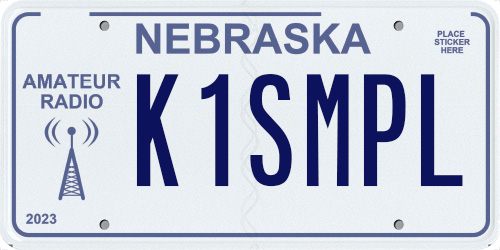
Nebraska front license plate requirements demand two plates on most vehicles today: Section 60-3,100 writes the two-plate rule into the motor vehicle code, and Section 60-399 sets the display standard, upright, plainly visible, unobstructed, mounted on the exterior the manufacturer built for it. A missing or badly mounted front plate gives an officer a lawful stop on sight, no driving behavior attached, and the citation class runs below registration violations on the state’s fine schedule.
Nebraska front plate rules cover the mounting surface, the visibility standard, the vehicle classes exempt from the front tag, and the 2017 windshield-decal path for vehicles without factory brackets. Under the statutory roadmap enacted through Legislative Bill 97, front-plate issuance will conclude at the 2029 reissue cycle, yet the mandate stands in full legal force until the schedule reaches each individual registration. This comprehensive reference covers every requirement in force today: mounting standards, visibility criteria, statutory exemptions, bracket compliance, citation classes, and the pre-trip checks a driver performs before operating on public roadways.
What the Front Plate Requirement Demands
Before appearing in person at your local County Treasurer’s office or submitting automotive applications by mail, you must assemble complete, legally binding documentation. Nebraska administrative law requires original certificates and state-approved application forms to establish clear legal ownership and statutory eligibility. Ensure you bring the mandatory documents and credentials listed below.
- Two plates on covered vehicles: front and rear, both issued with the registration.
- Upright mounting: the plate sits vertical, characters outward, on the mount the vehicle carries.
- Plain visibility: nothing blocks the characters: no tinted covers, no frames over the print, no grime that hides the tag.
- Exterior mounting: the plate fastens to the vehicle’s outside; windshield, visor, and dashboard placements fail the statute.
Courts have upheld stops on every interior placement. A plate taped to the glass, hung from a visor, or laid on a dash reads as a display violation on observation, and the stop stands.
Which Vehicles Need a Front Plate
Navigating the administrative rules and practical requirements for which vehicles need a front plate requires careful attention to both Nebraska Department of Motor Vehicles regulations and local County Treasurer practices. Whether you are managing personal vehicle compliance or handling complex multi-party automotive transactions, proper preparation is key to a seamless process. Review the essential guidelines, statutory criteria, and actionable recommendations detailed below.
| Vehicle class | Front plate | Display notes |
|---|---|---|
| Passenger cars | Required | Front and rear, upright, visible |
| Pickups and SUVs | Required | Same standard as passenger cars |
| Motorcycles | Not required | One plate, rear mounted |
| Trailers and semitrailers | Class rules | Follow trailer display placement |
| Dealer stock | Window permit | In-transit tags, rear window, driver side |
| Specialty and message plates | Required | Artwork changes, statute does not |
Specialty tags carry the same two-plate duty as standard issues, the mountain lion design, the Husker plate, the custom message combination. All mount front and rear on covered vehicles through the current cycle.
How To Mount a Front Plate Correctly
Successfully completing the legal and administrative requirements for how to mount a front plate correctly requires a structured, step-by-step approach coordinated between state DMV requirements and county processing counters. Following the verified statutory sequence ensures your application, certificate of title, and registration tags are validated without administrative rejection. Proceed through each procedural stage in the exact order detailed below.
- Locate the mount: the front bumper or grille bracket the manufacturer designed; most vehicles ship with drilled mounts or bracket kits in the trunk well.
- Fasten with plate bolts: the bolts seat through the plate’s slots into the mount; zip ties and adhesives fail the upright, secure standard on inspection.
- Check character visibility: step back twenty feet; every character and sticker reads clearly from outside.
- Test the swing: the plate holds firm; a swinging tag reads as improper mounting at a stop.
Aftermarket brackets solve the missing-mount case: tow-hook mounts, grille-clip brackets, and bumper kits hold the plate upright on vehicles without factory holes. The statute reads the result, upright, visible, exterior, not the brand of the bracket that holds it.
Vehicles Without Front Mounts: The 2017 Windshield Path
Since 2017, Nebraska has offered a specific administrative exemption for vehicles manufactured without a factory front license plate bracket or where mounting a bracket would cause physical damage to the vehicle’s bodywork. Under this statutory pathway, eligible motorists can pay an annual $50 special fee to receive an official state-issued windshield decal in place of mounting a physical front metal plate. This program provided the practical blueprint that led Nebraska lawmakers to pass the comprehensive single-plate reform taking effect statewide in 2029.

- Qualification: the vehicle class carries the two-plate duty, yet the model ships without a front mount and the design rejects clean aftermarket mounting.
- The decal route puts a front-plate decal issued through the registration in place of the physical tag.
- The rear plate stays physical: the decal covers the front duty; the rear tag carries the registration’s readable characters.
The decal path exists for the narrow case, drivers with mountable fronts mount the plate; the decal answers the design that cannot. County treasurer counters confirm a vehicle’s qualification at the registration transaction.
Plate Covers, Frames, and the Visibility Standard
Motor vehicle standards in Nebraska are codified under Nebraska Revised Statutes Chapter 60, establishing mandatory operational criteria for every vehicle on public roadways. Both state administrative directives and local county enforcement operate under these statutory mandates to maintain statewide public safety and vehicle identification integrity. The core legal rules and statutory obligations governing this area include.
- Clear covers that hide nothing: a cover that leaves every character and sticker readable passes the readability test.
- Tinted covers: any tint that dims the characters below readable fails, whatever the seller’s packaging says.
- Frames: a bracket that covers any part of the county prefix, serial, or stickers fails; a frame that leaves the print clear passes.
- Grime: road film that hides characters counts as obscured; the standard reads what an observer sees, not what the driver intended.
The test runs at twenty feet: step back from the rear of the car, and the front, since both plates carry the standard, and read the tag. If the characters read, the display passes; if anything hides them, the display fails, cover or no cover.
Photo evidence settles contested stops. A driver who photographs the tag from the stop distance carries the readability proof into the hearing, the same test the officer ran, recorded from the same angle. The converse holds: a cover vendor’s “legal in all 50 states” packaging means nothing against a photo that shows the characters dimmed behind tint. The readability standard is empirical, not contractual, what the observer reads decides, and the observer’s distance is the standard’s measure. Drivers who test covers in the store parking lot, phone camera at twenty feet, know the answer before the cover ever reaches the car.
Front Plate Citations: What a Stop Looks Like
Operating a vehicle in violation of Nebraska vehicle codes subjects drivers to immediate law enforcement stops, statutory traffic infractions, and escalating financial penalties. Nebraska State Troopers, county sheriff deputies, and municipal police officers actively enforce vehicle identification, display, and registration standards across all public roadways. The primary legal infractions, statutory classifications, and enforcement outcomes include.
- The observation: the officer reads the display failure from outside the vehicle; no driving behavior needs to accompany it.
- At the stop, license, registration, and insurance get requested per standard traffic-stop practice.
- The citation or warning: mechanical display fixes often draw warnings; the missing tag on a bracket-less car draws the citation schedule the county sets.
Fixing the mount ends the violation class for future stops, yet the citation for the observed date stands on its own, mounting the plate the same week does not erase the record. Drivers who photograph the corrected mount carry proof of the cure, useful at a hearing where the fix and the stop share a week.
Does LB97 Change Today’s Requirement?
No, not until the 2029 reissue cycle reaches the registration. LB97 passed April 2025 on a 46-0 vote and ends front-plate issuance at the next plate cycle, with multiyear registration in the same package. Because the transition runs on individual plate issue cycles rather than a blanket calendar date, vehicle owners should consult the official LB97 rollout schedule to determine precisely when their plate series will transition to a single rear plate.
- Registrations before the reissue window: two-plate duty in full force; a missing front tag cites under the current rule.
- Registrations at the reissue: the single rear plate issues with the cycle refresh.
- The fleet turns over: the two-plate fleet ages out as the cycle rolls through registrations.
A driver citing LB97 at a 2026 stop loses, the law’s operative date runs through the reissue, and the registration record states where each vehicle stands. The single-plate rule arrives with the plate; until then, Section 60-3,100 stands as written.
Buying a Used Vehicle: Front Plate Duty Transfers
Navigating the administrative rules and practical requirements for buying a used vehicle: front plate duty transfers requires careful attention to both Nebraska Department of Motor Vehicles regulations and local County Treasurer practices. Whether you are managing personal vehicle compliance or handling complex multi-party automotive transactions, proper preparation is key to a seamless process. Review the essential guidelines, statutory criteria, and actionable recommendations detailed below.
- Two-plate registration transfers: the buyer inherits the front-plate duty with the registration; both tags mount on delivery.
- Missing plates at sale: the buyer replaces through the county treasurer, $4.10 per plate, and the replacement pair carries the duty.
- Out-of-state arrivals: a vehicle entering Nebraska registration takes Nebraska plates with its first registration; the front tag mounts from day one inside the current cycle.
Dealers mount the tags they issue: a dealer-delivered vehicle arrives with plates fastened or in-transit tags in the rear window, the 30-day window runs on the same standard either way.
Front Plate Hardware: Brackets, Bolts, and Kits
Protecting your vehicle registration credentials and physical license plates against theft, tampering, or fraudulent duplication requires proactive physical security measures. Because vehicle tags and registration tabs are common targets for unauthorized acquisition by bad actors seeking to avoid vehicle taxes, preventative measures are essential. Implement the proven physical safeguards and best practices detailed below.
- Tow-hook mounts: thread into the front tow point; no drilling, upright hold, removal without a trace.
- Grille-clip brackets: clip into grille slats; fit varies by model, and the upright standard still applies.
- Bumper-mount kits: drill-and-bolt the classic route; the factory well’s drilled holes match on most models.
- Plate bolts: the fastener class matters; the tag holds firm against wind and wash, no swing, no rattle.
Statute reads the result: upright, visible, exterior, secure. The bracket brand never enters the test, the officer reads the tag, not the hardware catalog.
Rental Cars and Fleets
Navigating the administrative rules and practical requirements for rental cars and fleets requires careful attention to both Nebraska Department of Motor Vehicles regulations and local County Treasurer practices. Whether you are managing personal vehicle compliance or handling complex multi-party automotive transactions, proper preparation is key to a seamless process. Review the essential guidelines, statutory criteria, and actionable recommendations detailed below.
- Rental fronts: the agency mounts both plates; the renter’s duty runs on the display standard, nothing obscures the tag the agency fastened.
- Fleet plates: commercial registrations issue two-plate sets on covered classes; the fleet’s maintenance schedule keeps the mounts sound.
- Apportioned rigs: the IRP classes run their own plate rules through Motor Carrier Services; the display statutes apply on Nebraska roads the same way.
A missing front tag on a rental cites the registration, the agency’s record answers the display question, and the renter’s contract settles the fee responsibility between the parties.
Pre-Drive Checks: Thirty Seconds That Prevent the Stop
Operating a vehicle in violation of Nebraska vehicle codes subjects drivers to immediate law enforcement stops, statutory traffic infractions, and escalating financial penalties. Nebraska State Troopers, county sheriff deputies, and municipal police officers actively enforce vehicle identification, display, and registration standards across all public roadways. The primary legal infractions, statutory classifications, and enforcement outcomes include.
- Both plates present: front and rear, on the mounts.
- Characters readable: clean tags, no cover hiding the print, frame clear of the characters.
- Mounts secure: no swing, no rattle, the tag holds upright.
- Stickers current: the validation sticker reads inside its month.
The missing-plate stop ranks among the most common Nebraska traffic stops, and every one of them was preventable at the driveway. The check takes less time than the radio preset.
Common Front Plate Problems and Fixes
Administrative filings for nebraska front license plate requirements frequently encounter delays due to incomplete documentation, missing notarized signatures, or mismatched record details at the county counter. Because Nebraska County Treasurers must strictly follow state Department of Motor Vehicles regulations, even minor paperwork discrepancies will halt processing until cured. To protect your transaction timeline, avoid these common administrative filing errors.
| Problem | What the officer reads | Fix |
|---|---|---|
| Plate missing entirely | Unlawful on sight | Mount the tag; $4.10 replacement at the treasurer if lost |
| Plate in the windshield | Display violation — upheld stop | Exterior mount or the 2017 decal path |
| Tinted cover installed | Obscured characters | Remove the tint; clear covers pass |
| Frame over the characters | Partially hidden prefix or serial | Re-seat the frame clear of the print |
| Swinging mount | Improper mounting | Replace bolts; test the hold before the road |
Every fix costs less than the citation it prevents, the replacement plate runs $4.10 at the counter, the frame re-seats in a driveway, and the tinted cover removes in seconds. The stop costs the afternoon.
Model-Specific Mounting: What Drivers of Bracket-Less Cars Do
Modern sports cars, aerodynamic electric vehicles, and luxury European imports are frequently engineered and delivered without pre-drilled front bumper holes or mounting brackets. However, under current Nebraska traffic statutes, drivers remain legally obligated to display both plates until the 2029 statutory change takes effect. To avoid drilling into factory bumpers or receiving traffic citations, many Nebraska motorists utilize non-invasive tow-hook license plate adapters, grille-clamping brackets, or motorized stowaway brackets that maintain legal visibility without compromising vehicle aesthetics.
- Check the trunk well first: most manufacturers ship the bracket kit with the car; the well holds the bracket, bolts, and the template.
- Tow-hook mount for the no-drill case: threads into the front tow point; upright, secure, reversible without a trace.
- Nostril and grille-clip mounts: fit varies by model line; the upright standard applies whatever the clip.
- Drill-and-bolt when the design accepts it: the classic route; the template marks the holes and the bumper carries the tag like the factory intended.
- The decal qualification check: designs that reject every mount ask the county treasurer about the 2017 path before the citation asks first.
The statute reads the result, not the hardware catalog, upright, visible, exterior, secure. The route to that result is the driver’s choice.
Front Plate and Vehicle Inspections at Sale
Navigating the administrative rules and practical requirements for front plate and vehicle inspections at sale requires careful attention to both Nebraska Department of Motor Vehicles regulations and local County Treasurer practices. Whether you are managing personal vehicle compliance or handling complex multi-party automotive transactions, proper preparation is key to a seamless process. Review the essential guidelines, statutory criteria, and actionable recommendations detailed below.
- Both plates transfer with the registration: the buyer mounts front and rear on day one; a sale that hands over one plate leaves the buyer short at the first stop.
- Replacement before the sale closes: a missing tag replaces at the treasurer counter ($4.10) before the buyer drives off, cleaner than the citation the gap invites.
- Plate condition at sale: bent, faded, or illegible tags replace the same way; the readability standard applies to the transfer the same as it applies to the road.
Dealers handle the tags they issue: delivery arrives with plates fastened or the in-transit tag in the rear window, the 30-day dealer window runs its course either way.
Weather, Car Washes, and Mount Longevity
Motor vehicle standards in Nebraska are codified under Nebraska Revised Statutes Chapter 60, establishing mandatory operational criteria for every vehicle on public roadways. Both state administrative directives and local county enforcement operate under these statutory mandates to maintain statewide public safety and vehicle identification integrity. The core legal rules and statutory obligations governing this area include.
- Road salt and brine: corrosion attacks cheap brackets and bolts; the twice-a-year hardware check catches the rust before the tag swings.
- Automatic car washes: the brushless pass spares the tag; the brush pass pulls on loose mounts. The swing test after the wash tells the story.
- Highway speeds: a loose tag lifts and swings at speed; the citation reads improper mounting even when the tag never leaves the car.
The driveway check adapts to the seasons: the swing test after the first freeze, the readability test after the first brine week, and the bolt check each spring. Thirty seconds a month keeps the display statute satisfied year-round.
Frequently Asked Questions
Find clear answers to recurring questions about Nebraska front license plate regulations, mounting standards, and statutory enforcement. These answers explain current two-plate mandates under statute Section 60-3,100, acceptable hardware configurations, how patrol officers enforce front plate violations, and what motorists can expect when the state transitions to a single rear plate in 2029.
Does Nebraska require a front license plate right now?
Yes. Section 60-3,100 demands two plates on covered vehicles through the current cycle, front and rear, upright, visible under Section 60-399. The rule retires at the 2029 reissue cycle under LB97, passed April 2025 on a 46-0 vote. Until the cycle reaches a registration, both plates mount.
What happens if you drive without a front plate in Nebraska?
A lawful stop on observation alone, no driving behavior needs to accompany the display failure. The officer requests license, registration, and insurance, then writes a citation or warning on the county’s schedule. Mounting the plate ends future stops; the citation for the observed date stands on its own record.
Can I put my front plate on the dashboard in Nebraska?
No. Interior placements fail the statute, windshield, visor, and dashboard mounts have all drawn upheld stops in Nebraska courts. The plate fastens to the vehicle’s exterior on the mount the design carries. Vehicles with no mount at all qualify for the 2017 windshield-decal path through the registration, a preview of the 2029 single-plate rule.
Do I need a front plate on my motorcycle or trailer?
No. Motorcycles carry one plate, rear mounted; trailers and semitrailers follow their class display rules. The two-plate duty covers the classes built for front mounting, cars, pickups, SUVs, and the exempt classes run on the rear tag alone, the same display standard on every plate that mounts.
Are license plate covers legal in Nebraska?
Clear covers that hide nothing pass; anything that dims or blocks the characters fails. The Section 60-399 test reads what an observer sees from outside the vehicle: tinted covers, frames over the print, and grime that hides characters all fail the readability standard. The twenty-foot driveway test settles every cover question before the road does.
Mounting hardware matters as much as the plate itself. Nebraska expects the front plate fixed at the designed mount point, not leaning in a windshield or taped to a bumper edge, and an obscured plate number reads the same as a missing plate at a traffic stop. The 4 dollar 10 cent per-plate fee funds the issue, and the county stacks its 1 dollar 50 cent charge at renewal. The 2029 reissue under LB97 retires the front mount for covered vehicles, and until then Section 60-3,100 keeps the two-plate rule in force. Display questions route to the Driver and Vehicle Records desk at 402-471-3918, and county treasurer offices handle local plate checks.