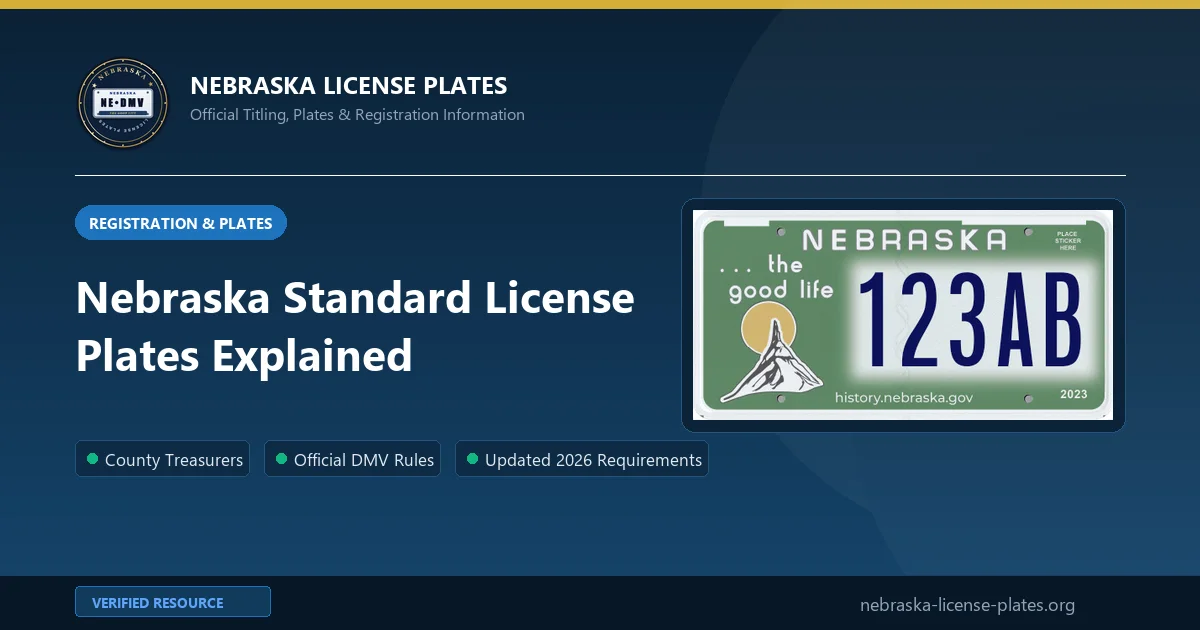
The Nebraska standard plate runs the county-coded serial system the state has carried since 1922, the low county numbers to Douglas, Lancaster, and the early vehicle counts, the letters behind the numbers building on the same county logic. The plate identifies the county of issue at a glance, and the system survives every design refresh since.
This page covers the county prefix coding, the serial formats by period and class, the reissue cycle that refreshes physical plates, the fee stack on a standard issue, the 2029 single-plate change under Legislative Bill 97, and how the standard plate runs on every vehicle class in the state.
The County Prefix: How Nebraska Codes Its Plates
Nebraska codes standard plates by county population rankings, which motorists can identify using the complete county plate prefix lookup table. Both state administrative directives and local county enforcement operate under these statutory mandates to maintain statewide public safety and vehicle identification integrity. The core legal rules and statutory obligations governing this area include.
Douglas: 1, the largest fleet at the coding. Lancaster: 2, second at the count. The rest in order: 3 through 93 run down the 1922 vehicle counts, and the assignments have held for a century.
A tag reading 2 ABC123 identifies Lancaster County issue, and a 1 tag Douglas. The specialty designs and message plates drop the county face but keep the county record underneath, the issuing treasurer ties every tag to its county file.
Serial Formats and What the Letters Mean
Before appearing in person at your local County Treasurer’s office or submitting automotive applications by mail, you must assemble complete, legally binding documentation. Nebraska administrative law requires original certificates and state-approved application forms to establish clear legal ownership and statutory eligibility. Ensure you bring the mandatory documents and credentials listed below.

The early decades ran a county number and a short serial. The 1951 expansion moved to number-letter blocks as the fleet grew. The modern formats pair the number with three letters and three digits on the standard face, the letters cycling as the combinations fill.
The serial format is registration bookkeeping, not personal identity. The letters cycle through the pool, and the record behind the tag, not the tag itself, carries the owner file at the county treasurer.
The Reissue Cycle: Why Plates Refresh
Navigating the administrative rules and practical requirements for the reissue cycle: why plates refresh requires careful attention to both Nebraska Department of Motor Vehicles regulations and local County Treasurer practices. Whether you are managing personal vehicle compliance or handling complex multi-party automotive transactions, proper preparation is key to a seamless process. Review the essential guidelines, statutory criteria, and actionable recommendations detailed below.
Roughly five years pass between full fleet refreshes. The trigger is the aging reflective sheeting and the readability standard from Section 60-3,99, which demands legible characters. The cost lands as the standard plate fee per plate at reissue, the $4.10 under Section 60-3,102, inside the registration transaction.
The 2029 cycle carries the single-plate change. Legislative Bill 97, passed April 2025 on a 46-0 vote, ends front-plate issuance at the 2029 reissue, and the cycle rolls the change through the fleet as each registration reaches its reissue window.
What the Standard Plate Costs
Total financial obligations for what the standard plate costs are governed by standardized statutory schedules set forth under Chapter 60 and Chapter 77 of the Nebraska Revised Statutes. Fees are collected directly by your local County Treasurer and comprise multiple distinct lines, including state motor vehicle taxes based on age and MSRP, county administrative charges, and local municipal wheel taxes where applicable. The essential fee classifications and payment structures are broken down as follows.

Plate fee: 4 dollars 10 cents per plate, the pair on covered vehicles costs 8 dollars 20 cents through the current cycle, under Section 60-3,102. County official fee: 1 dollar 50 cents under Section 60-3,141. Registration and motor vehicle tax: the standard schedule by MSRP, age, and weight. Sales tax on a purchase: 5.5 percent state plus local additions on the price.
No premium sits on the standard face. The message program carries its 40 dollar fee and the specialty designs their premiums, and the standard tag runs the base stack alone.
The 2029 Single-Plate Change
Navigating the administrative rules and practical requirements for the 2029 single-plate change requires careful attention to both Nebraska Department of Motor Vehicles regulations and local County Treasurer practices. Whether you are managing personal vehicle compliance or handling complex multi-party automotive transactions, proper preparation is key to a seamless process. Review the essential guidelines, statutory criteria, and actionable recommendations detailed below.
Front plate: not issued at the 2029 cycle forward, the rear plate only. Multiyear registration: available for qualifying vehicles under the same bill. Transition: registrations before the cycle keep two plates until the reissue reaches them, and the change rolls with the reissue schedule, not a calendar date.
The standard plate through the current cycle stays the two-plate issue, front and rear, upright and visible under Section 60-3,99. The 2029 change lands at the reissue window, and every fee and display rule on this page carries the current-cycle answer until then.
Standard Plates on Every Vehicle Class
Nebraska codes standard plates by county population rankings, which motorists can identify using the complete county plate prefix lookup table. Both state administrative directives and local county enforcement operate under these statutory mandates to maintain statewide public safety and vehicle identification integrity. The core legal rules and statutory obligations governing this area include.
Passenger cars: the two-plate class through the current cycle. Pickups and SUVs: the passenger-truck classes on the truck fee schedule. Motorcycles: the single-plate class, rear mount. Trailers and semitrailers: the class display rules. Dealer stock: the in-transit permits on the window.
The county coding ties every class to its issue file. The motorcycle tag carries its county number on the small face, and the trailer classes run their own serial blocks. The record at the treasurer links the tag, the class, and the county in one line.
The County Number List: The Big Ten
Navigating the administrative rules and practical requirements for the county number list: the big ten requires careful attention to both Nebraska Department of Motor Vehicles regulations and local County Treasurer practices. Whether you are managing personal vehicle compliance or handling complex multi-party automotive transactions, proper preparation is key to a seamless process. Review the essential guidelines, statutory criteria, and actionable recommendations detailed below.
Douglas holds 1 with Omaha and the largest file, Lancaster holds 2 with Lincoln, and Sarpy takes the suburban growth number from the original coding. The big ten adds the Hall, Buffalo, Dodge, Madison, Platte, Scotts Bluff, and Lincoln county files that carry the heaviest traffic.
The numbers read on the road. A 1 tag crossed the state lines and the Omaha origin reads at a glance, the century-old coding doing the work the GPS does with satellites.
A Standard Issue Walkthrough at the Counter
Registering a passenger vehicle with standard Nebraska license plates involves a predictable series of steps at your local county treasurer counter. Upon arrival, present your assigned certificate of title, proof of active Nebraska auto liability insurance, and sales tax documentation. The deputy treasurer verifies your vehicle’s situs, calculates state registration fees and motor vehicle taxes, and hands you your metal plates with validation stickers.
Bring the assigned title or the manufacturer certificate, the insurance card, the photo ID, and the odometer statement. The fee stack runs the plate fee at $4.10 per plate, $8.20 the pair, the county fee at $1.50, the motor vehicle tax on the schedule, and the sales tax on the purchase at 5.5 percent state plus local. The issue: the county-coded pair prints same-day at most counters, and the sticker carries the staggered month.
The reissue clock starts. The pair serves the cycle, roughly five years, and the 2029 refresh carries the single-plate change under LB97, the rear plate only at the next issue.
The Reissue Calendar: What a Cycle Looks Like
Nebraska vehicle administrative law strictly enforces statutory deadlines for registration renewals, title transfers, and temporary permit expirations. Failing to file within established state windows triggers automated statutory late fees and exposes motorists to unlawful operation citations under Nebraska Revised Statutes. Review the critical statutory timelines and filing deadlines outlined below.
The county posts the reissue window in the notice, pointing to the registration month that carries the new plates. Your renewal runs with the plate swap, and the old pair surrenders at the counter. The cycle rolls through the counties and the staggered months, refreshing the fleet over the year, not one morning.
The 2029 cycle runs the biggest swap. The single-plate issue lands with the multiyear registration option, and the front plate retires at the reissue transaction, the change LB97 wrote into the code.
The Standard Plate and the County Record
Before appearing in person at your local County Treasurer’s office or submitting automotive applications by mail, you must assemble complete, legally binding documentation. Nebraska administrative law requires original certificates and state-approved application forms to establish clear legal ownership and statutory eligibility. Ensure you bring the mandatory documents and credentials listed below.
At issue, the county-coded pair prints against the registration, and the number reads the county. The treasurer file carries the plate, the owner, the vehicle, and the insurance check on one line. When you move, the situs change files at the next transaction, the plate keeps its number, and the record moves to the new county.
The specialty and message plates drop the county face and keep the county tie. The program designs print their artwork, and the record underneath runs the same county line the standard issue runs.
The Plate on the Used Car: What Stays and What Moves
The standard tag answers the sale with fixed rules. The seller keeps the plates: they come off at the exchange, and they transfer to a replacement vehicle of the same class or surrender at the counter. The buyer gets a new pair printed against the new title, coded to the buyer’s situs county, and the staggered month keys to the buyer’s surname.
The plate never rides the sale. The vehicle trades clean, the paperwork carries the identity, and the tags tie to the owner’s file. The county record follows the person, not the car.
The Sticker on the Standard Plate
The validation month reads the renewal status. The sticker sits on the rear plate, in the lower corner the design sets, with the face out. The month number and the year must stay visible at the twenty-foot distance, the same display test the characters run. The new sticker covers the old at each renewal, and the counter issues the current print with the paid stack.
A faded sticker fails the statute. The readability rule covers the sticker along with the print, and an unreadable month draws the same citation class as hidden characters. A fresh sticker at the renewal counter is the cheapest fix on the schedule.
The County Prefix in Daily Reads
The number maps the state at a glance. The 1 tags read as Omaha, the Douglas fleet on every road in the state. The 2 tags read as Lincoln, the Lancaster file. The low numbers meet the high numbers on every highway, the 1922 map rolling past in both directions.
The specialty designs hide the number and keep the map. The county record ties the artwork to its file, and a treasurer pull answers the county question the specialty face never prints.
The Standard Plate and the Specialty Application
Motorists who initially register their vehicles with standard Nebraska license plates can upgrade to a specialty or personalized plate design at any time. When you file a specialty application, you keep your standard plates on the vehicle until the custom plates arrive at the county treasurer office, at which point you simply exchange the standard plates for your new specialty tags.
The stack runs the same base underneath. The plate fee at 4 dollars 10 cents per plate under Section 60-3,102 serves every issue, the county fee at 1 dollar 50 cents under Section 60-3,141 serves every transaction, and the program premium sits above the base on the specialty side alone.
The Plate Pair Through the Seasons
Nebraska’s extreme weather—from scorching summer road heat to harsh winter blizzards and road de-icing brine—can take a severe toll on license plates over a five-year cycle. Washing your plates during spring to remove corrosive salts and periodically checking mounting hardware ensures your plates remain fully readable and compliant with state display laws.
The seasonal care keeps the statutory read. The twenty-foot test answers the plate the same way in July and January, and the maintenance minutes a month keep the citation class off the record.
Reading a Standard Plate at a Glance
The standard face answers three questions in one read. The leading number names the county, the serial block marks the registration, and the sticker carries the coverage month and year. The county name prints along the face, and the state mark seals the identity.
The read takes a second. An officer, a toll camera, or a parking attendant pulls the same three answers off the face, and the county record behind the tag holds the rest. The face serves the road, the record serves the counter, and the two never swap jobs.
Key Points: Nebraska Standard Plates at a Glance
Understanding the core statutory rules governing Nebraska Standard License Plates Explained in Nebraska ensures your automotive filings clear state verification without unnecessary delays or counter rejections. Whether you are completing paperwork at your local county treasurer’s counter or checking current compliance across state roadways, keep these fundamental legal requirements in mind.
County coding: the leading number names the county, the 1922 map, Douglas 1 through the smallest fleet.
Plate fee: 4 dollars 10 cents per plate under Section 60-3,102, the pair at 8 dollars 20 cents.
County fee: 1 dollar 50 cents under Section 60-3,141, every transaction at the counter.
Pair display: the front and rear pair runs through the cycle, and the 2029 reissue under LB97 moves the fleet to a single rear plate.
Sticker: the rear plate carries the coverage month and year, the swap at each renewal.
Sale rule: the plates stay with the seller, and the buyer prints a new pair on the new title.
Reissue cycle: the roughly five-year cycle prints new metal inside a renewal transaction.
The eight lines carry the everyday plate. The coding answers the county at a glance, the fees price the pair at the counter, and the sticker carries the coverage month the road reads. The sale keeps the tags with the owner, the reissue refreshes the metal on the cycle, and the 2029 change closes the front-plate period the pair has run since the coding began.
The Standard Plate Fee Lines
Total financial obligations for the standard plate fee lines are governed by standardized statutory schedules set forth under Chapter 60 and Chapter 77 of the Nebraska Revised Statutes. Fees are collected directly by your local County Treasurer and comprise multiple distinct lines, including state motor vehicle taxes based on age and MSRP, county administrative charges, and local municipal wheel taxes where applicable. The essential fee classifications and payment structures are broken down as follows.
| Line | Amount | Statute |
|---|---|---|
| Plate fee per plate | $4.10 | Section 60-3,102 |
| Two-plate pair | $8.20 through current cycle | Section 60-3,102 |
| County official fee | $1.50 | Section 60-3,141 |
| Motor vehicle tax | 49 MSRP bands, age steps | Section 60-3,185 |
| Motor vehicle fee | $5, $20, $30 by weight and age | Section 60-3,185 |
| Sales tax on purchase | 5.5% state plus local | Nebraska Revenue |
The closing read on the standard plate is the pair of details most owners need once. The plates belong to the owner file, not the vehicle, so every sale, trade, or move hands the car on without the tags, and the counter prints the pair the new record draws. The coverage lives on the sticker, the identity lives on the county number, and the two answers ride the same face the road reads. The 2029 reissue will retire the front plate and change the design, and the standard stack the treasurer runs prices the same base beneath every specialty face the state sells. The plate the coding serves has answered the county question for a century, and the record behind it answers the rest.
Frequently Asked Questions
Below are clear, factual answers to frequently asked questions regarding nebraska standard license plates explained under Nebraska Revised Statutes and official county treasurer administrative guidelines. Whether you are navigating statutory filing deadlines, calculating applicable state and local motor vehicle taxes, or verifying required documentation before visiting your local county office, these concise answers explain the exact legal requirements and procedures that govern motor vehicle administration in Nebraska.
What do the numbers on Nebraska plates mean?
The leading number is the county code from the 1922 vehicle count, 1 for Douglas, 2 for Lancaster, through 93. The coding has held for a century, and a tag reading 2 with letters identifies Lancaster County issue. Specialty and message plates drop the county face but keep the county record underneath.
How often does Nebraska reissue standard plates?
Roughly every five years on a rolling cycle. The reflective sheeting ages, and the readability standard in Section 60-3,99 sets the legible-characters bar. The reissue runs inside the registration transaction at the standard plate fee. The 2029 cycle carries the single-plate change under LB97.
How much does a standard Nebraska plate cost?
The plate fee runs 4 dollars 10 cents per plate under Section 60-3,102, 8 dollars 20 cents for the current-cycle pair. The county official fee adds 1 dollar 50 cents under Section 60-3,141, and the registration schedule carries the motor vehicle tax. No premium sits on the standard face.
Does Nebraska issue two standard plates?
Yes, through the current cycle, on the classes built for front mounting. Section 60-3,100 writes the two-plate rule. The 2029 reissue ends front-plate issuance under Legislative Bill 97, passed April 2025 on a 46-0 vote. Registrations keep two plates until the reissue reaches them.
Can I keep my Nebraska plate when I move counties?
The plate follows the registration, and the registration sits at the situs county, where the vehicle lives most of the year. A move between counties changes the registration situs at the next transaction. The county-coded face keeps its number, and the record moves to the new county file.
What happens to old Nebraska plates at reissue?
The county treasurer collects the old pair at the new issue. The old tag retires from the pool, and the reflective sheeting recycle runs through the state program. Surrender rules apply on the plate swap, and the counter takes the old pair with the reissue paperwork.